Professional exterior care
What pressure washing is for
Start with the surface and its condition—not with how powerful the machine is.
Get a quote
Our own work
See the difference
- Before
 After
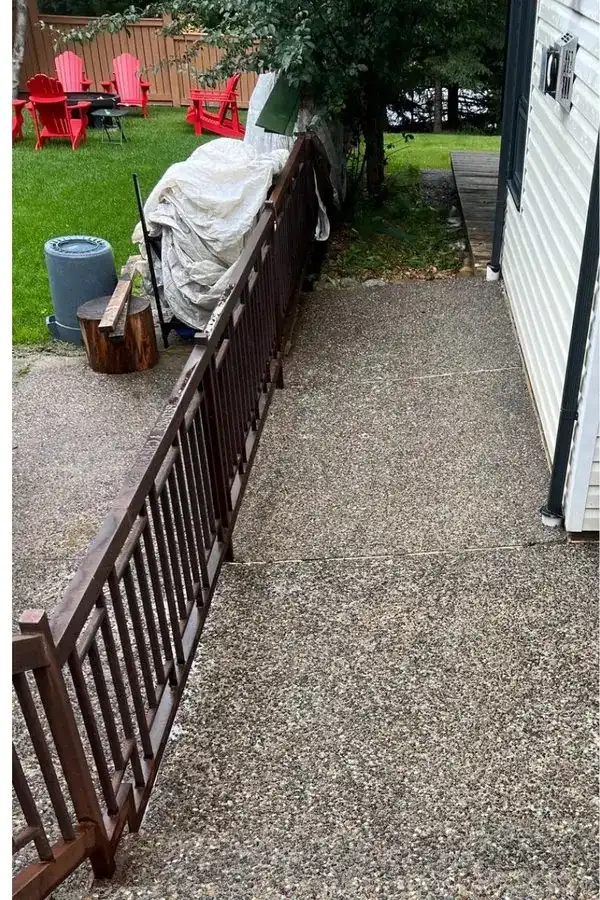
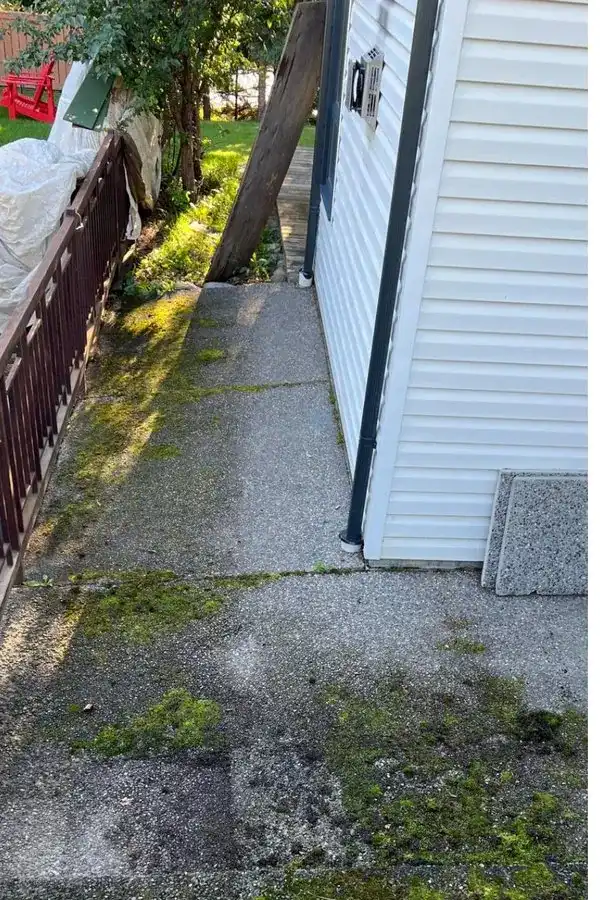
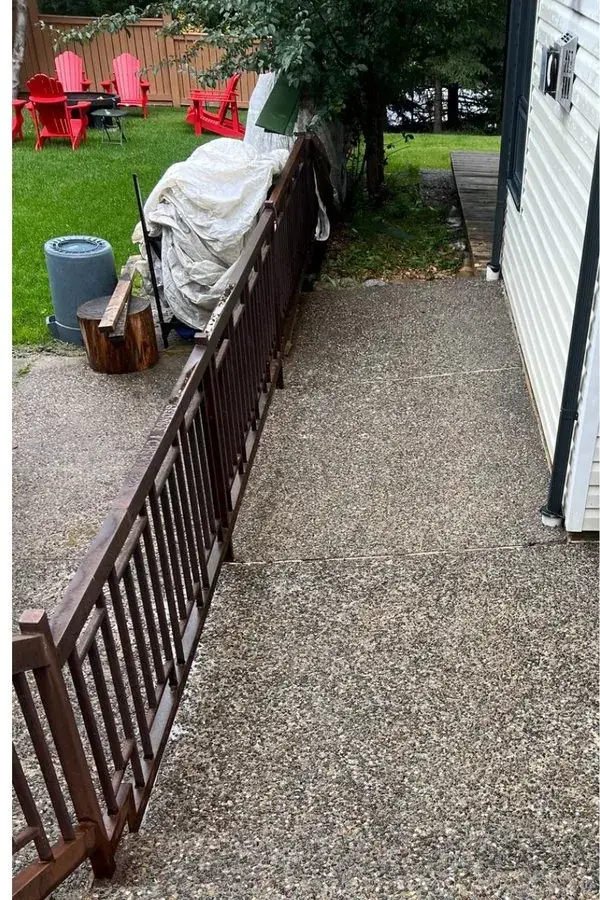
Pressure Washing Organic growth removed from an exposed-aggregate walkway


The short version
What to expect
- Best fit
- Suitable driveways, walkways, patios and steps
- Checked first
- Material, condition, joints and existing damage
- Standard scope
- Organic growth, dirt, crack clearing and cleanup
- Discuss separately
- Oil, rust, sealing and paver joint sand
- Never pressure washed
- Roofs, siding, soffits, paint and fences
Start with the surface, not the machine
Sound concrete, pavers, brick and some stone can be suitable for pressure washing. The material, age and existing wear still need to be checked before work begins; a hard surface is not automatically an undamaged one.
On suitable flatwork, Shine uses a wand or surface cleaner according to the surface. Organic growth may be pre-treated, cracks are cleared, and the resulting mess is cleaned up rather than pushed to the edge of the property.
Pavers need a joint-sand check
Interlocking pavers can be pressure washed, but nozzle choice, distance and spray angle matter. Pressure can remove joint sand or worsen existing weak spots, so the condition of the joints belongs in the quote—not as a surprise after cleaning.
Re-sanding is not part of Shine's confirmed standard scope. If the joints are already low or loose, ask what the cleaning is likely to change before accepting the quote.
Sources: Concrete Masonry & Hardscapes Association: cleaning and joint-sand guidance
Siding and roofs need a different method
Shine does not pressure wash siding, soffits, painted surfaces, fences or roofs. Those surfaces need a lower-pressure, material-specific approach; roof moss removal is a separate hand-removal and treatment service.
That distinction is supported by the manufacturers. James Hardie advises against pressure washing its fibre-cement siding, while the Asphalt Roofing Manufacturers Association warns that pressure washing asphalt shingles can cause granule loss and premature failure.
Sources: James Hardie: cleaning fibre-cement siding · ARMA: cleaning asphalt roofing systems
What a useful quote should answer
A clear quote identifies the actual surface, the areas included, the marks you are concerned about and anything outside the standard scope. Oil, rust, failed concrete, sealing and joint-sand replacement should not be assumed to disappear inside a general “pressure washing” line item.
Send photographs if you have them, but expect the crew to confirm the condition on site. Cleaning can remove dirt and organic growth; it cannot repair a surface that is already flaking, loose or permanently stained.
Free quote
Ready for a price?
Tell us where the property is and what you need cleaned. The short form takes about a minute.
What you are actually buying
This is the standard our crew works to on this job — not a summary written for the website. It is worth reading the second and third lists before you book anyone, ours or anybody else's.
Included as standard
- Organic growth and dirt taken off flat surfaces with a wand or a surface cleaner, whichever gets that surface properly clean.
- Where growth needs killing before it will wash off, the treatment is part of the job.
- Cracks in the driveway are blown out.
- The mess is cleaned up, including any dirt carried out onto the road.
Not included
- The public sidewalk in front of a residential property.
- Oil stains, unless it has been agreed in advance.
- Rust marks.
- Weeds growing between bricks.
When we stop and call you
Our crew is not allowed to push on through any of these. They stop and phone you rather than press on and make it worse.
- You want oil stains gone — we will talk about what is actually achievable before starting.
- The work cannot be done safely.
Local service details
See pricing and service information for your area, or call your local team.
You do not need to be home
- Access to the yard
- Gates unlocked
- Pets inside
- An outdoor tap we can use
Pressure Washing: the questions we get
What do you pressure wash, and what do you not?
Concrete, pavers, stone and brick get pressure. Siding, soffits, paint, fences and roofs get soft washed instead.
Why not pressure wash siding? It would be faster.
Because it forces water behind the cladding, where it has no way out. What you gain in speed you pay for in a wall that stays wet.
Can you damage concrete with a pressure washer?
Yes, if it is already deteriorating. Exposed aggregate that has lost its binder sheds stone, and we check before starting rather than after.
Why is my driveway green?
Algae, fed by a mild wet winter and shade. It is the same coastal damp that grows moss on the roof, on a flat surface instead.
Can you do my exposed aggregate?
Usually, at reduced pressure, after looking at it. Aggregate that has already lost binder sheds stone under pressure and does not come back.
Will this fix my flaking concrete?
No. Spalling is freeze-thaw damage in the concrete itself. Washing makes it visible; it does not repair it, and we will say so.
Does the road salt come off?
The surface residue does. What salt and freeze-thaw have already done to the concrete underneath does not wash out.
- 700+ five-star Google reviews Across both Victoria and Prince George.
- The right method for the surface Soft washing for delicate surfaces. Pressure washing for suitable hard surfaces.
- Fully insured and WorkSafeBC registered Our business is insured and registered with WorkSafeBC.
- Locally owned, since 2019 Working on Vancouver Island and in northern BC.